


Article published in SegurosNews
Generative Artificial Intelligence is rapidly reshaping the digital transformation of the insurance industry. Driven by AI agents, systems capable of analyzing information, executing tasks, coordinating processes and making decisions autonomously within insurers’ operational workflows, the market is in full evolution.
This process has accelerated over the last 3 or 4 years. In fact, a study by EIOPA (the European Insurance and Occupational Pensions Authority) states that almost two-thirds of insurance companies in Europe are using or experimenting with generative AI, although most projects are still at the proof-of-concept or pilot stage.
In Spain, the most recent analyses show that 4 in 10 insurers are actively using AI, although they face challenges related to regulation, data protection and the difficulty of finding the right talent to make the most of this technology.
However, it is AI agents that have the real potential to deliver a major technological leap for the industry by optimizing complex, end-to-end processes within insurers, with a strong impact on costs and turnaround times. While it is tempting to think of AI in terms of traditional chatbots, AI agents have very different capabilities, since they can interact with different data sources, integrate with any API and execute tasks end to end within companies’ internal systems, from underwriting to claims management and customer service. And all of this autonomously.
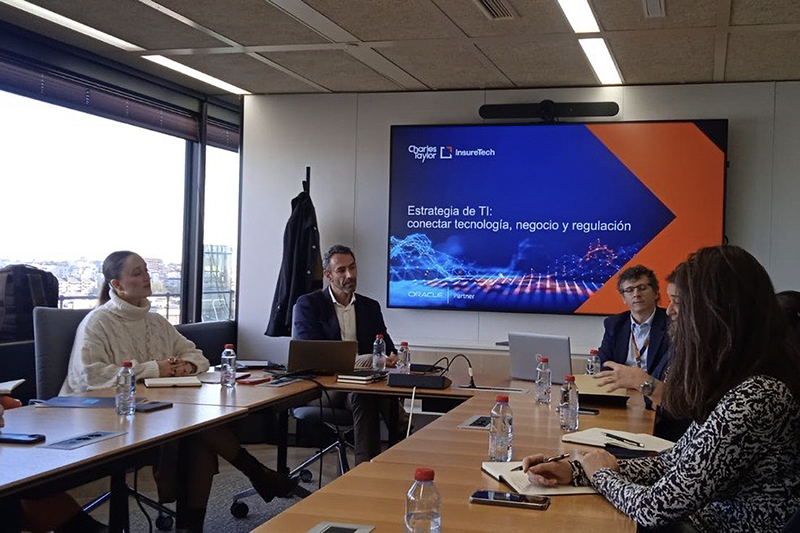
“AI agents represent a paradigm shift for the industry. It’s not just about automating customer conversations, as classic chatbots do, but about embedding operational intelligence into business processes,” explains Raúl Fernández Villota, Business Development Manager at Charles Taylor InsureTech in Iberia, who recently moderated a conference on the topic at the latest edition of Semana del Seguro.
Market data confirm the growing interest in these technologies. A Deloitte report notes that 76% of insurance organizations have already deployed generative AI capabilities in at least one business function, evidence of a change in mindset in an industry that has historically been cautious about adopting technology. “When designed correctly, these agents can act as an orchestration layer that connects data, systems and decisions within the company,” the expert highlights.
The main challenge is not adopting this technology, since the numbers are positive in that respect, but making sure adoption is efficient and effective. A global study by Boston Consulting Group states that only 7% of insurers have managed to implement AI at scale across their organization. Most are still in the pilot stage, which might suggest a lack of confidence in AI agents making decisions autonomously. Nothing could be further from the truth. In fact, AI agents can become a key tool for accelerating the industry’s transformation, since their main applications include automating claims processes, supporting risk underwriting, detecting fraud and improving the customer experience through intelligent assistants capable of querying multiple systems at the same time.
“For years, the industry has invested in digitalization and in modernizing its core systems. Now we are entering a different stage: the cognitive automation of end-to-end processes,” adds Fernández Villota. “Insurers that start experimenting with AI agents today will be better positioned to compete in the market of the future.” Ultimately, the question the insurance industry is asking today is no longer whether it will use generative artificial intelligence, but when and how it will integrate AI agents into its day-to-day operations.
In this context of technological transformation, understanding the reality of companies in the industry is key. That is why we invite readers to share their experience and perspective by answering the following survey on the use of artificial intelligence agents in their organizations.